Beneficio de una muestra tecnológica de skarn magnetítico del yacimiento “La Yuca” de posible empleo en investigaciones criminalísticas
Article Sidebar
Main Article Content
Abstract
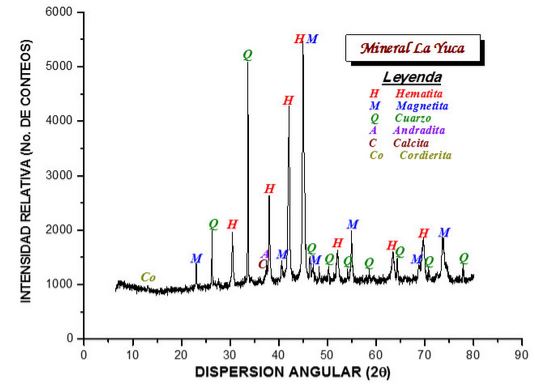
With the aim of obtaining a Fe-magnetic concentrate for possible use in those uses where large volumes of ore to be processed are not required; example in criminalistics researches, a magnetic benefit scheme is characterized and applied by dry way from a representative sample of the Fe skarn deposit linked to the "Hierro Santiago" mineral field, through the use of various instrumental techniques of analytical mineralogy and physical / chemical tests.The mineralogical composition of the sample under evaluation allows a combined technological scheme to be selected: (1) crushing - grinding - pulverizing (range granulometric; - 0.106 + 0.074 mm); (2) dry magnetic separation (Int. (H) < 200 kA/m; Int (I amp) = 0); (3) granulometric separation (wet method) of the concentrates and (4) drying of both at room temperature. As a result of the benefit, a magnetic concentrate is achieved that presents a notable increase in the magnetite grade (92.16%) and 7.84% of mineral impurities, for a total accumulated weight of 78.80%. it meets the minimum contents of useful mineral for use in the following applications: (1) synthesis of ferrites; (2) magnetic powders for fingerprint printing and (3) composites for biomedicine.In order to achieve environmental sustainability with the implementation of the concept of cleaner technologies (CT), the subsequent evaluation of the non-magnetic fraction product of the mill is proposed as an abrasive material for cleaning metallic surfaces and ornamental stones in construction facilities, given by the content of phases of notable hardness that were identified in its mineralogical composition: hematite (30%), quartz (21%), andradite (17%), cordierite (14%), magnetite (13%) and minor quantities of calcite ( 5%) respectively.
This article serves as a modest tribute to the memory of the technologist Rubén Alcalá Fariñas, an excellent specialist in the benefit of minerals, a dear friend of all CIPIMM colleagues.
Article Details

This work is licensed under a Creative Commons Attribution-NonCommercial 4.0 International License.
Those authors who have publications with this journal accept the following terms:
- The authors will retain their copyright and guarantee the magazine the right to first publish their work, which will be simultaneously subject to the Creative Commons 4.0 Recognition-NonCommercial Recognition License that allows third parties to share the work whenever it is indicate its author and its first publication this magazine. Under this license the author will be free from:
- Share - copy and redistribute the material in any medium or format
- Adapt - remix, transform and create from the material
- The licensor cannot revoke these freedoms while complying with the terms of the license
Under the following conditions:
- Recognition - You must properly recognize the authorship, provide a link to the license and indicate if changes have been made. You can do it in any reasonable way, but not in a way that suggests that you have the support of the licensor or receive it for the use you make.
- NonCommercial - You may not use the material for a commercial purpose.
- There are no additional restrictions - You cannot apply legal terms or technological measures that legally restrict what the license allows.
- Authors may adopt other non-exclusive licensing agreements for the distribution of the version of the published work (e.g., deposit it in an institutional telematic archive or publish it in a monographic volume) provided that the initial publication in this journal is indicated.
- Authors are allowed and recommended to disseminate their work through the Internet (e.g., in institutional telematic archives or on their website) before and during the submission process, which can produce interesting exchanges and increase citations. of the published work. (See The effect of open access).
The magazine is not responsible for the opinions and concepts issued in the works, they are the sole responsibility of the authors. The Editor, with the assistance of the Editorial Committee, reserves the right to suggest or request advisable or necessary modifications. The mention of trademarks of specific equipment, instruments or materials is due to identification purposes, there being no promotional commitment in relation to them, neither by the authors nor by the publisher.
References
Alfonso E., Bercoff P.G. & Alonso J.A. 2011. “Procesamiento para obtener ferritas a partir de materiales de desecho de la industria del níquel”. INFOMIN, Vol.3 (No.2): 43-51, ISSN: 1992-4194. Available: <http://www.infomin.co.cu>, [Consulted: December 3, 2021].
Allen, Teresa M. & Cullis, Pieter R. 2004. “Drug delivery systems: Entering the mainstream”. Science, vol. 303(No. 5665), March: 1818-1822.
Anthony, J. W., Bideaux, R. A., Bladh, K. W. & Nichols, M. C. 2005. Handbook of Mineralogy, Mineralogical Society of America.
Arisi, E.; Bergenti I.; Cavallini, M.; Murgia, M.; Riminucci, A.; Ruani, G. & Dediu, V. 2007. “Room temperature deposition of magnetite thin films on organic substrate”. Journal of Magnetism and Magnetic Materials, vol. 316 (No. 2): 410-412.
Betetjtin A.1971. Curso de Mineralogía, Moscú: Editorial Mir.
Betetjtin A.1971. Cristalografía y mineralogía física, Moscú: Editorial Mir.
Blakemore, Richard. 1975. “Magnetotactic bacteria”. Science, vol. 190(No.4212), October: 377-379.
Bohannon, John. 2000. “A home for Maori science”. Science, vol. 318 (No. 5852), November: 907.
Cornell, Rochelle M. & Schwertmann, Udo .1996. The iron oxides. Weinheim, Germany: VCH
Diebel, Carol E.; Proksch, Roger; Green, Colin R.; Neilson, Peter and Walker & Michael M. 2000. “Magnetite defines a vertebrate magneto receptor”. Nature, vol.406 (No. 6793), July: 299-302.
Evans, R. C.1966. An introduction to crystal chemistry. 2nded. Cambridge: Cambridge University Press
Estupiñán. Y. 2002. Obtención de pre-reducidos a partir de minerales de hierro del sector Yuca de Santiago de Cuba. Trabajo de Diploma. Fondo D´SIT
Figueredo. O.; García, L. L.; Cubillo, C.; Castaño, O. & Morciego, O.1989. Perspectivas de utilización de minerales magnetíticos del yacimiento “Hierro Santiago” en la industria siderúrgica nacional. I/89, 41p.
Figueredo O. 1990. Estudio del beneficio por separación magnética de la muestra # 3 del sector “La Grande” del yacimiento de hierro de Santiago de Cuba, Informe Nº 1.
Figueredo. O.; García, L. L.; Cubillo, C.; Castaño, O. & Morciego, O. 1990. “Beneficio por separación magnética de los minerales de los yacimientos Chiquita, Chicharrones y El Descanso, pertenecientes al grupo de yacimientos de Santiago”. Boletín Siderurgia. I/90: 61 - 71.
Fritzsche, Wolfgang & Taton T, Andrew. 2003. “Metal nanoparticles as labels for heterogeneous, chip-based DNA detection”, Nanotechnology, vol. 14(No. 12):R63-R73.
Fu, Qiang; Rama Rao, G. V.; Ward, Timothy L.; Lu, Yunfeng; & Lopez, Gabriel P. 2007. “Thermoresponsive transport through ordered mesoporous silica/ PNI PAAm copolymer membranes and microspheres”.Langmuir, vol. 23(No. 1):170-174.
García I, Aja R & otros.2005. Producción de hierro esponja a partir de minerales de hierro cubanos. Informe final de proyecto de Investigación, La Habana, CIPIMM.
Gómez-Lopera, Salvador; Arias, José L.; Gallardo, Visitación & Delgado, Ángel V. 2006. “Colloidal stability of magnetite /poly (lactic acid) core/shell nanoparticles”. Langmuir, vol. 22: 2816-2821.
Guliáev A.P. 1978. Metalografía, Moscú, Editorial Mir.
Hernández. G., N. González. 1989. Estudio del beneficio de la muestra tecnológica del sector Concordia del Yacimiento Hierro Santiago. Proyecto de Grado. Fondo D´SIT.
Holden, Constance.2004. “Magnetic art”, Science, vol.305 (No. 5684):603.
Lavandero, R., Estrugo, M., Santa Cruz, M., Bravo, F., Melnikova, A., Cabrera, R., Trofimov, V. A., Romero, J. & otros.1988. Mapa de yacimientos minerales de Cuba a escala 1: 500 000. Ministerio de la Industria Básica, Instituto de Geología y Paleontología.
Leyva Mormul A, Leyva Ramírez E, Leyva González O, Figueredo Stable O & Ferreiro Guerrero Y.2007. Evaluación de las características fisicoquímicas y mineralógicas de la mena de hierro del grupo de yacimientos Hierro Santiago, Dique Norte, La Pasa, Nicaro, Holguín. Centro de Investigaciones Siderúrgicas, D´SIT.
López-Pereiro.2014. Fabricación de Hierro, Aceros y Fundiciones. 1ª Ed. J. Apraiz Barreiro
Lovaina. Y. & Naranjo E. 1989. Estudio del beneficio de la muestra del Sector Antoñica del Yacimiento Hierro Santiago. Proyecto de Grado. Fondo D´SIT.
Medina, A., Gilart, M., Ruiz, R., Gil M., Acosta J., Guerra M., Cobián T., (1990), Informe sobre los trabajos de exploración detallada hierro La Grande, realizados durante los años 1983 - 85 y 1987 - 92: Inédito
Moreira J, Torres J.L., Montano J, Lavandero R, Sánchez R & Cazañas X. 2011. Yacimientos de minerales sólidos cubanos, IV Congreso de Geología y Minería.
Padró, T., Cadete, M., Ferro, P. & Cobián T. 1990. Informe sobre los trabajos de prospección detallada Hierro Firmeza realizados durante los años 1978 - 85 y 1987 - 88 en la provincia Santiago de Cuba: Inédito.
Philipse, A P; van Bruggen, Michel P. B & Pathmamanoharan, C.1994. “Magnetic silica dispersions: Preparation and stability of surface-modified silica particles with a magnetic core”. Langmuir, vol.10 (No.1), January: 92-99.
Portal, Figueredo Y. 2015. Obtención de un concentrado magnético a partir de menas de skarn magnetítico del yacimiento La Yuca. Tesis de diploma, Unidad Docente Metalúrgica (UDM), ISPJAE.
Sánchez, R., 1997. Reporte de cierre sobre las investigaciones realizadas por la AEI Carib Gold Mines Inc. - Geominera S. A. en el proyecto Sierra Maestra Oriental (Smor): Inédito.
Santisteban E. 1990. Caracterización y preparación de la muestra del sector Chiquita del Yacimiento hierro Santiago de Cuba. Trabajo de Diploma. Fondo D´SIT
Tada, D B.; Vono, Lucas L. R.; Duarte, E L.; Itri, R; Kiyohara, P K.; Baptista, Mauricio S. & Ross, Liane M. 2007. “Methylene blue-containing silica-coated magnetic particles: A potential magnetic carrier for photodynamic therapy”. Langmuir, vol. 23: 8194-8199.
Walker, M M.; Diebel, C E.; Haugh, C V.; Pank-hurst, P M.; Montgomery, J C. & Green, C R. 1997. “Structure and function of the vertebrate magnetic sense”. Nature, vol. 390(No.6658), November: 371-376.
Zhu, R. X.; Potts, R.; Xie, F.; Hoffman, K. A.; Deng, C. L.; Shi, C. D.; Pan, Y. X.; Wang, H. Q.; Shi, R. P., Wang, Y.C.; Shi, G. H. & Wu, N. Q. 2004. “New evidence on the earliest human presence at high northern latitudes in northeast Asia”. Nature, vol. 431 (No. 7008), September: 559-562.
Zinchenko, V., Ferro, P. & Cobián, T. 1988, Informe de exploración orientativa y detallada del yacimiento Yuca del Campo Mineral Hierro Santiago: Inédito.
Zinchenko, V., Ferro, P. & Cobián, T. 1989. Informe de exploración detallada del yacimiento Antoñica del campo menífero Hierro Santiago: Inédito.