Ciencia Abierta para la minería cubana: INFOMIN
Article Sidebar
Main Article Content
Abstract
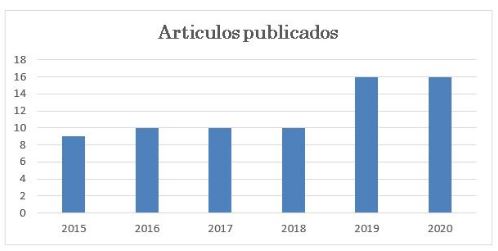
Open Science, today gains more strength and followers, both in the country and globally, there are multiple examples of its use, since it promotes collaborative research and the socialization of scientific knowledge for the benefit of society. In this sense, the objective of this work is to present the CIPIMM Open Science initiative, through the bibliometric study of the scientific production of the INFOMIN Magazine, in the period between 2015-2020 based on the analysis of the published fascicles. To this end, several quantitative and qualitative indicators were used, such as: total articles published, thematic lines with the greatest coverage, word co-occurrence analysis, total articles by country and institution, and number of papers published by the most productive authors. The results indicate a positive trend towards improvement in the levels of editorial quality and visibility of the INFOMIN journal (http://www.infomin.co.cu ), which allowed it to be indexed in DOAJ. It is suggested to deepen the investigation, incorporating its application in new Information Systems such as REDALYC.
Article Details

This work is licensed under a Creative Commons Attribution-NonCommercial 4.0 International License.
Those authors who have publications with this journal accept the following terms:
- The authors will retain their copyright and guarantee the magazine the right to first publish their work, which will be simultaneously subject to the Creative Commons 4.0 Recognition-NonCommercial Recognition License that allows third parties to share the work whenever it is indicate its author and its first publication this magazine. Under this license the author will be free from:
- Share - copy and redistribute the material in any medium or format
- Adapt - remix, transform and create from the material
- The licensor cannot revoke these freedoms while complying with the terms of the license
Under the following conditions:
- Recognition - You must properly recognize the authorship, provide a link to the license and indicate if changes have been made. You can do it in any reasonable way, but not in a way that suggests that you have the support of the licensor or receive it for the use you make.
- NonCommercial - You may not use the material for a commercial purpose.
- There are no additional restrictions - You cannot apply legal terms or technological measures that legally restrict what the license allows.
- Authors may adopt other non-exclusive licensing agreements for the distribution of the version of the published work (e.g., deposit it in an institutional telematic archive or publish it in a monographic volume) provided that the initial publication in this journal is indicated.
- Authors are allowed and recommended to disseminate their work through the Internet (e.g., in institutional telematic archives or on their website) before and during the submission process, which can produce interesting exchanges and increase citations. of the published work. (See The effect of open access).
The magazine is not responsible for the opinions and concepts issued in the works, they are the sole responsibility of the authors. The Editor, with the assistance of the Editorial Committee, reserves the right to suggest or request advisable or necessary modifications. The mention of trademarks of specific equipment, instruments or materials is due to identification purposes, there being no promotional commitment in relation to them, neither by the authors nor by the publisher.
References
Anglada, L. & Abadal E. 2018.”¿Qué es la ciencia abierta?”. Anuario Think EPI, (2): 6, Doi:https://doi.org/10.3145/thinkepi.2018.43. Citado en Vitón Castillo et al., 2020. Available: < http://scielo.sld.cu/scielo.php?script=sci_arttext&pid=S1028-99332020000200168 >, [Consulted: july 3, 2022]
Arencibia Arrebola, Daniel Francisco, Betancourt López, Virginia; González-Alfalla, Norka, Puig Fernández, Yamira, Biart La Rosa, Orquídea, Fernández Sanguinety, Danilo Felipe & Ochoa Azze, Rolando Felipe. 2014. Estudio bibliométrico de la producción científica de VacciMonitor (2000- 2013). VacciMonitor, 23(2):41-48. Available: < http://www.finlay.sld.cu/vaccimonitor.html>, [Consulted: july 3, 2022]
Dinu NR & Baiget T. 2019. “Presente y futuro de las revistas científicas”. Scire, 25(1): 9. Available:<https://www.ibersid.eu/ojs/index.php/scire/article/view/4611>, Consulted: july 3, 2022].
European Comission. 2016.Open innovation, open science, open to the world - a vision for Europe. Luxembourg: Publications Office of the European Union]. Available:<https://ec.europa.eu/digital-single-market/en/news/open-innovation-open-science-open-world-vision-europe>, [Consulted: july 3, 2022].
Garduño Oropeza, O. Taller Calidad Editorial y Fortalecimiento de la producción de Revistas Científicas Cubanas. REDALYC.
Juárez, Rolando Pablo. 2020. Análisis bibliométrico de la producción científica internacional relacionada con la saliva. Revista Cubana de Información en Ciencias de la Salud, 31(2): 1525. Available: < http://scielo.sld.cu/scielo.php?script=sci_arttext&pid=S2307-21132020000200010&lng=es&tlng=es. >, [Consulted: july 3, 2022].
Lotka AJ. 1926. The frequency distribution of scientific productivity. J Wash Acad Sci. 16(12):317-23.
Romaní, Franco, Huamaní, Charles, & González Alcaide, Gregorio. 2011. Estudios bibliométrico como línea de investigación en las ciencias biomédicas: Una aproximación para el pregrado. CIMEL Ciencia e Investigación Médica Estudiantil Latinoamericana, Vol. 16(1): 52-62 Federación Latinoamericana de Sociedades Científicas de Estudiantes de Medicina Lima, Organismo Internacional. Available:<http://www.redalyc.org/articulo.oa?id=71723602008>, [Consulted: july 10, 2022].
Salgado Machin, I. 2012. INFOMIN, canal de comunicación y certificación de los resultados investigativos de la comunidad minero metalúrgica cubana. Memorias del Congreso Info´2012. , Cuba: Palacio de las Convenciones de La Habana, ISBN: 978-959-234-081-7.
Salgado Machín, I.; Hernández, I, Castellanos, J, Delgado, Blasa & Alfonso, Esteban. 2013. Valoración del impacto del patrimonio científico del CIPIMM. Memorias de Geociencias. V Convención Cubana de Ciencias de la Tierra, Cuba: Palacio de las Convenciones de La Habana, ISBN: 2307-499X .
van Eck NJ & Waltman L. 2010 Software survey: VOSviewer, a computer program for bibliometric mapping. Scienometrics, 84(2):523-38.
Vitón-Castillo, Adrián Alejandro, García-Espinosa, Eveline, & Arencibia-Paredes, Nieves María.2020.Bases para la implementación de la ciencia abierta.Revista Información Científica,99(2):168-177. Available:<http://scielo.sld.cu/scielo.php?script=sci_arttext&pid=S1028-99332020000200168&lng=es&tlng=es >, [Consulted: july 10, 2022].