Evaluation of ACINOX Tunas white slag as a binder in the development of concrete blocks
Article Sidebar
Main Article Content
Abstract
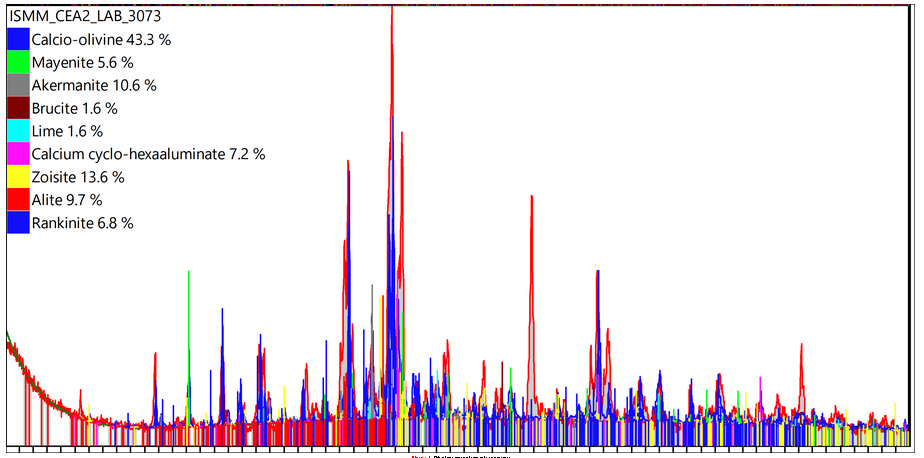
The company ACINOX Las Tunas is one of the main steel plants in Cuba, where there is considerable experience in the use of white slags as binders in mortars, as a substitute for Portland cement. In recent years, there has been an unmet demand for construction materials for housing. The aim of this study was to evaluate the use of white slags as a binder in the development of concrete blocks. For this purpose, slag with a particle size between 0 and 1 mm and 35 MPa Portland cement were used. The slags were characterized through chemical analysis using Atomic Absorption Spectrometry and mineralogical analysis using X-ray Diffraction. Blocks with dimensions of 395x95x195 mm were prepared with different mixes (slag-cement) and were evaluated by compressive strength tests at 28 and 60 days, using a ZIM press, model RSA-123. Through qualitative mineralogical analysis, it was found that the slag is composed of typical cement phases such as akermanite, merwinite, alite, and mayenite, as well as calcium-olivine, calcium cyclo-hexa-aluminate, zoisite, rankinite, pseudowollastonite-4, brucite, and lime. The chemical analysis reported that the slag is mainly composed of oxides of calcium, silicon, iron, magnesium, aluminum, and manganese. Based on the chemical composition of the slag, a hydraulicity index of 0.44 was calculated, classifying it as primarily hydraulic lime according to Mazzochi. The block samples with 50% and 60% slag dosages developed compressive strength exceeding 2.5 MPa and are classified as type III, according to the Cuban standard NC-247:2010.
Article Details

This work is licensed under a Creative Commons Attribution-NonCommercial 4.0 International License.
Those authors who have publications with this journal accept the following terms:
- The authors will retain their copyright and guarantee the magazine the right to first publish their work, which will be simultaneously subject to the Creative Commons 4.0 Recognition-NonCommercial Recognition License that allows third parties to share the work whenever it is indicate its author and its first publication this magazine. Under this license the author will be free from:
- Share - copy and redistribute the material in any medium or format
- Adapt - remix, transform and create from the material
- The licensor cannot revoke these freedoms while complying with the terms of the license
Under the following conditions:
- Recognition - You must properly recognize the authorship, provide a link to the license and indicate if changes have been made. You can do it in any reasonable way, but not in a way that suggests that you have the support of the licensor or receive it for the use you make.
- NonCommercial - You may not use the material for a commercial purpose.
- There are no additional restrictions - You cannot apply legal terms or technological measures that legally restrict what the license allows.
- Authors may adopt other non-exclusive licensing agreements for the distribution of the version of the published work (e.g., deposit it in an institutional telematic archive or publish it in a monographic volume) provided that the initial publication in this journal is indicated.
- Authors are allowed and recommended to disseminate their work through the Internet (e.g., in institutional telematic archives or on their website) before and during the submission process, which can produce interesting exchanges and increase citations. of the published work. (See The effect of open access).
The magazine is not responsible for the opinions and concepts issued in the works, they are the sole responsibility of the authors. The Editor, with the assistance of the Editorial Committee, reserves the right to suggest or request advisable or necessary modifications. The mention of trademarks of specific equipment, instruments or materials is due to identification purposes, there being no promotional commitment in relation to them, neither by the authors nor by the publisher.
References
Boza Regueira, M.H. 2011. Utilización de las escorias de acería como material de construcción. Ciencia & Futuro, vol. 1 (no. 4): 31- 40, ISSN: 2306-823X.
Boza Regueira, M.H., Estrada Cingualbres, R. & Sánchez Soler, E. 2017. Tejas onduladas de fibrocemento con escorias de acería. 8VA Conferencia Científica Internacional de la Universidad de Holguín, Cuba, pp. 1-9.
Caballero Garrido, A.A., Montenegro Cooper, J.M. & Ponce Abarca, R.A. 2017. Caracterización de la escoria blanca proveniente de la siderurgia integral.Chile: Universidad Catolica de la Santisima Concepcion.
Cañas Gallart, J. & Aguado de Cea, A. 2012. Estudio del comportamiento de hormigones con áridos siderúrgicos de horno eléctrico. España: Universitat Plitécnica de Catalunya.
Espinosa Borges, A.E., Almenares Reyes, R.S., Leyva Rodríguez, C.A. & Alarcón Pérez, L.R., 2023. Estudio fraccionario de las escorias blancas de ACINOX Las Tunas para su empleo como materiales cementicios suplementarios. Cuba: Universidad de Moa.
FMI. 2022. Perspectivas de la economía mundial: La guerra retrasa la recuperación mundial. Disponible en: <https://www.imf.org.pdf >[Consultado: Febrero 15, 2024].
Fernández Pérez, A., Zúñiga Igarza, L.M. & Urbina Reynaldo, M.O. 2017. Evaluación de escoria de acería de horno de arco en hormigones de 20.0 MPa.
García Avilés, E. & Beyris Mazar, P.E., 2014. Escorias blancas de acería como material de construcción. Moa, Cuba: Instituto Superior Minero Metalúrgico de Moa “Dr. Antonio Núñez Jiménez”.
León Aguilar, I. & Almenares Reyes, R.S. 2017. Evaluación de escorias blancas de acería como sustituto parcial de cemento Portland. Moa, Cuba: Instituto Superior Minero Metalúrgico de Moa “Dr. Antonio Núñez Jiménez” Facultad de Metalurgia y Electromecánica.
Otegi Aldai, K., Vázquez, E., Barra, M. & Aponte, D., 2012. Estudio del impacto ambiental por lixiviación de la escoria de acería en capas granulares no ligadas 706-TFM-314. España: Universidad Politécnica de Cataluña.
Santamaría Vicario, I., Rodríguez Sáiz, Á. & Calderón Carpintero, V., 2015. Fabricación de morteros de albañilería con escoria negra de horno eléctrico de arco EAF y escoria blanca de horno cuchara LF. España: Universidad de Burgos Escuela Politécnica Superior.
Sosa Gutiérrez, A. & Cuetara Ricardo, J.R. 2019. Evaluación de morteros de albañilería elaborados con áridos reciclados mixtos y escoria blanca en reemplazo del hidróxido de calcio. Ciencia & Futuro, vol. 9 ( no.3): 81-97, ISSN: 2306-823X.
Wang, H., Tsai, S., Hung, C. y Jian, T., 2022. Research on engineering properties of cement mortar adding stainless steel reduction slag and pozzolanic materials. Case Studies in Construction Materials [en línea], vol. 16 ( no. April): 01144, ISSN: 2214-5095. DOI: 10.1016/j.cscm.2022.e01144. Disponible en: <https://doi.org/10.1016/j.cscm.2022.e01144>[Consultado: Febrero 15, 2024].
Zelada Muñoz, R. & Rodriguez Castillo, A. 2016. Valoración económica de la escoria de horno eléctrico de siderperu como producto alternativo a la piedra cantera en el sector construcción. Perú: Universidad Nacional de Trujillo. Disponible en: http://dspace.unitru.edu.pe/bitstream/handle/UNITRU/14465/Aguilar Ramos Cesar Hilton.pdf?sequence=1&isAllowed=y [Consultado: Febrero 15, 2024]